Are Greenworks Batteries Interchangeable With Ryobi? Essential Guide
No, Greenworks batteries are NOT interchangeable with Ryobi batteries. While both brands offer popular cordless tools powered by lithium-ion batteries, their battery systems are designed differently and are not compatible with each other. Attempting to force a battery or use adapters can damage your tools and void warranties.
Hey there, fellow DIYers and home project enthusiasts! Md Meraj here. If you’ve ever found yourself staring at a Greenworks drill and a Ryobi trimmer, or even just thinking about expanding your cordless tool collection, you’ve probably wondered if the batteries could do double duty. It’s a common question, and for good reason! We all love to save money and reduce clutter. But when it comes to power tools, compatibility is key. Let’s cut to the chase: Greenworks and Ryobi use proprietary battery systems.
This means a Greenworks battery won’t fit a Ryobi tool, and vice versa. It’s like trying to use a Ford key in a Chevy ignition – they’re just not made to connect! This guide will walk you through why this is the case, how to make sure you’re buying the right batteries for your tools, and what you can do to manage your battery ecosystem efficiently.
Why Batteries Aren’t Universal: The Tech Behind It
It’s tempting to think that all battery-powered tools should share a common power source, but the reality is a bit more complex. Here’s a peek under the hood:
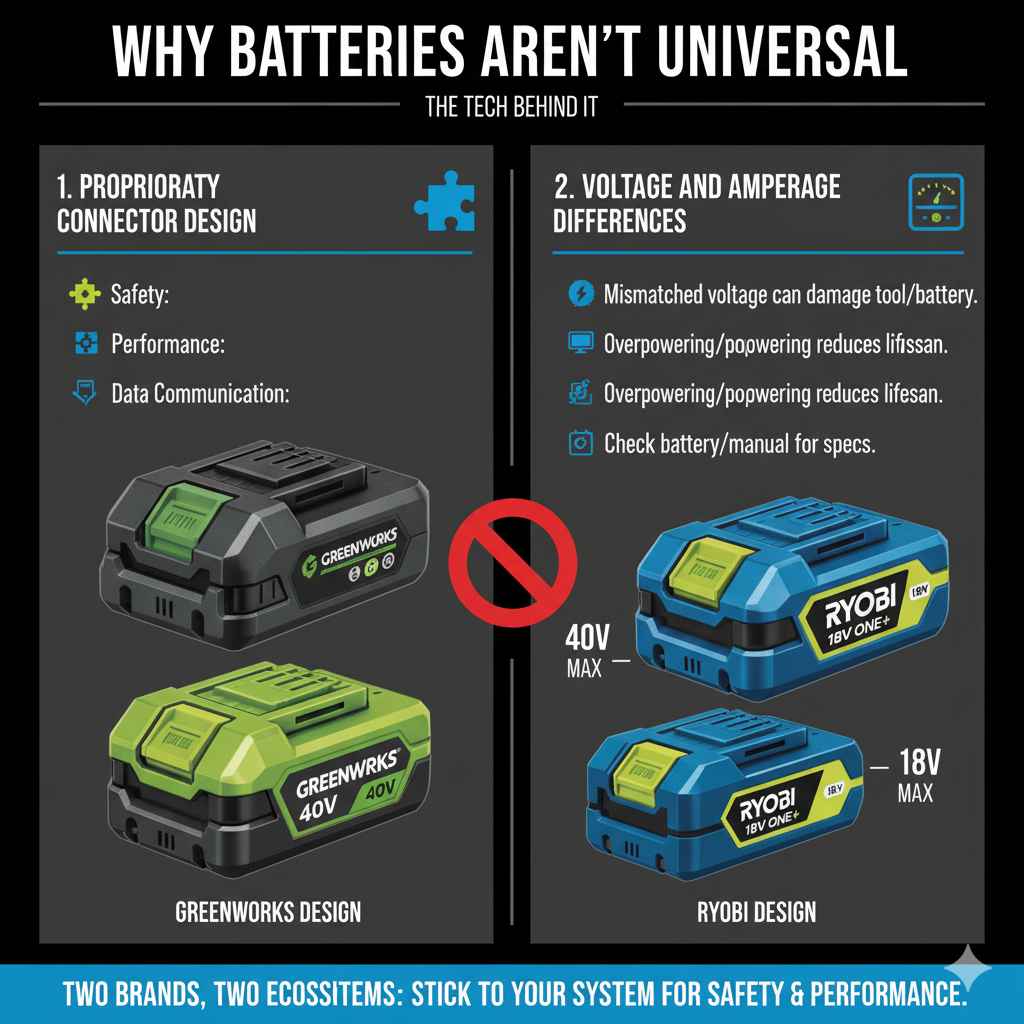
1. Proprietary Connector Design
Manufacturers like Greenworks and Ryobi carefully design the battery connectors and the tool ports. These are specific to their product lines. Think of it like a puzzle piece: each battery has a unique shaped connector that only fits into the equally unique slot on its matching tool. This isn’t just to make things difficult; it’s crucial for several reasons:
- Safety: Correctly designed connections ensure the right voltage and current flow, preventing overheating or electrical shorts.
- Performance: The connection is engineered for optimal power transfer, ensuring your tool performs at its best.
- Data Communication: Many modern batteries communicate with the tool and charger, relaying information about charge level, temperature, and battery health. Mismatched connectors would prevent this vital communication.
2. Voltage and Amperage Differences
Even if you could physically connect a Greenworks battery to a Ryobi tool (which you can’t without risking damage), the electrical specifications might be wildly different. Batteries come in various voltages (e.g., 18V, 20V, 40V, 60V) and amperages (Ah). Using a battery with the wrong voltage can severely damage the tool or the battery itself. Overloading a tool with too much power or underpowering it with too little can lead to poor performance and shortened lifespan. Information on battery voltage can often be found on the battery itself or in your tool’s manual.
3. Intellectual Property and Market Strategy
Battery technology is a significant part of a tool manufacturer’s brand identity and business model. By creating their own unique battery systems, companies like Greenworks and Ryobi encourage customers to invest in their ecosystem. This means that if you buy a Ryobi tool, you’re more likely to buy other Ryobi tools to use with your existing Ryobi batteries. This strategy helps them maintain quality control and ensures that their tools and batteries work together seamlessly.
Understanding Your Tool’s Battery System
The best way to avoid compatibility confusion is to know your tools and their power sources. Both Greenworks and Ryobi offer a wide range of battery-powered tools, each designed for specific tasks around the home and garden.
Greenworks Battery Systems
Greenworks is well-known for its extensive range of outdoor power equipment, but they also offer indoor tools. They primarily operate on several key voltage platforms:
- 24V System: A common choice for lighter-duty tools like trimmers, blowers, and smaller drills.
- 40V System: A very popular platform for a wide array of lawn mowers, trimmers, chainsaws, and even some indoor tools.
- 60V System: For more demanding outdoor tasks, offering higher power for robust mowers, snow blowers, and hedge trimmers.
- 80V System: Their highest voltage system, designed for professional-grade outdoor power equipment.
Greenworks batteries are designed with specific connectors and housing to ensure they only work with Greenworks tools within the same voltage platform. For example, a 40V Greenworks battery will only fit 40V Greenworks tools.
Ryobi Battery Systems
Ryobi is famous for its “One+ System,” which is a massive ecosystem of over 260 tools that all share the same 18V battery platform. This offers incredible flexibility for homeowners. Beyond 18V, Ryobi also offers higher voltage systems:
- 18V ONE+ System: The cornerstone of their offering, this system powers everything from drills and saws to vacuums and garden tools. The batteries are designed with a unique sliding mechanism and internal contacts that are specific to Ryobi’s 18V line.
- 18V/40V Hybrid System: Some larger Ryobi tools can accept either an 18V battery (often with an adapter) or a dedicated 40V battery for increased power and runtime.
- 40V System: A dedicated platform for more powerful outdoor equipment like snow blowers, powerful mowers, and high-performance trimmers. These batteries are distinct from their 18V offerings.
- HBP (High Power Brushless) System: Ryobi’s premium line, usually featuring 40V or higher, designed for maximum performance.
Crucially, within each Ryobi system (e.g., 18V ONE+), the batteries are interchangeable among qualifying tools. However, an 18V ONE+ battery will not fit a 40V Ryobi tool, and likewise, a 40V battery won’t work in an 18V ONE+ tool.
So, Can Greenworks Batteries Fit Ryobi Tools? The Definitive Answer
To be absolutely clear, the answer is no. Greenworks batteries and Ryobi batteries are electrically and physically incompatible. There is no way to safely and reliably use a Greenworks battery in a Ryobi tool, or vice-versa. If you were to find some kind of adapter (which are generally not recommended or officially supported), you would be risking significant damage to your tools, the batteries, and potentially yourself.
Attempting to force a battery into a port it doesn’t fit can:
- Bend or break the internal contacts in the tool or on the battery.
- Cause short circuits, leading to battery failure or tool damage.
- Result in improper power delivery, leading to poor tool performance or overheating.
- Void the warranties on both your tools and batteries.
Always stick to the batteries specifically designed for your tools. You can usually find this information on the tool itself, in the user manual, or on the manufacturer’s website. Reputable sources like the U.S. Department of Energy’s consumer battery information can also provide general insights into battery technology and safety.
When You Might See Similarities (And Why They Don’t Matter)
You might see batteries from both brands that look somewhat alike. They are often black or green and have a similar rectangular shape. Many use lithium-ion technology. However, these superficial similarities are where the commonalities end. The critical internal components, the shape of the electrical contacts, the housing, and the locking mechanisms are all unique to each brand and their specific battery platforms.
For example, both brands offer 40V batteries. While the voltage is the same, the physical design and connector pins are different. A 40V Greenworks battery has a specific plug configuration, and a 40V Ryobi battery has a different one. These are not interchangeable.
What If You Have Both Greenworks and Ryobi Tools?
It’s quite common for DIYers and homeowners to own tools from different brands. Perhaps you inherited some Ryobi tools and bought a Greenworks mower, or vice versa. Here’s how to manage this:
1. Keep Batteries Organized
The simplest solution is to maintain separate battery sets for each brand. Label your chargers and batteries clearly if you have many. This prevents accidental mix-ups.
2. Invest in Charger and Battery Kits
When buying new tools, it’s often most economical to purchase them as a kit that includes a battery and charger. This ensures you get the correct, compatible power source.
3. Consider Battery Capacity (Ah)
When you need to buy a replacement battery or an additional one, pay attention to the Amp-hour (Ah) rating. A higher Ah rating means longer runtime on a single charge. For example, a 4.0Ah Greenworks battery will perform similarly in terms of runtime and power to another 4.0Ah Greenworks battery, but it’s still not compatible with Ryobi tools. For Ryobi, a 18V 9.0 Ah ONE+ battery will offer more runtime than an 18V 2.0 Ah ONE+ battery, but both will work on any compatible Ryobi 18V ONE+ tool.
4. Sell or Donate Unused Batteries
If you’ve consolidated your tools to one brand or simply have spare batteries, consider selling them to someone who uses that specific system or donating them to a local charity or community workshop. Check out resources like EPA guidelines on electronics recycling to see how to properly dispose of old batteries if they can’t be reused.
Can You Use Third-Party Batteries?
This is another area where caution is crucial. While some third-party battery manufacturers exist, their compatibility with Greenworks or Ryobi tools is often questionable and carries risks:
- Quality Control: Non-brand batteries may not meet the same rigorous quality and safety standards as original manufacturer batteries.
- Performance Issues: They might not deliver consistent power, leading to slogging tools or abrupt shutdowns.
- Warranty Voidance: Using third-party batteries almost certainly voids the warranty of your tools and possibly the battery itself.
- Safety Hazards: Poorly manufactured batteries can pose fire or explosion risks.
For peace of mind and optimal tool performance, it’s almost always best to stick with genuine Greenworks batteries for your Greenworks tools and genuine Ryobi batteries for your Ryobi tools. The Consumer Product Safety Commission (CPSC) often provides safety alerts regarding battery products.
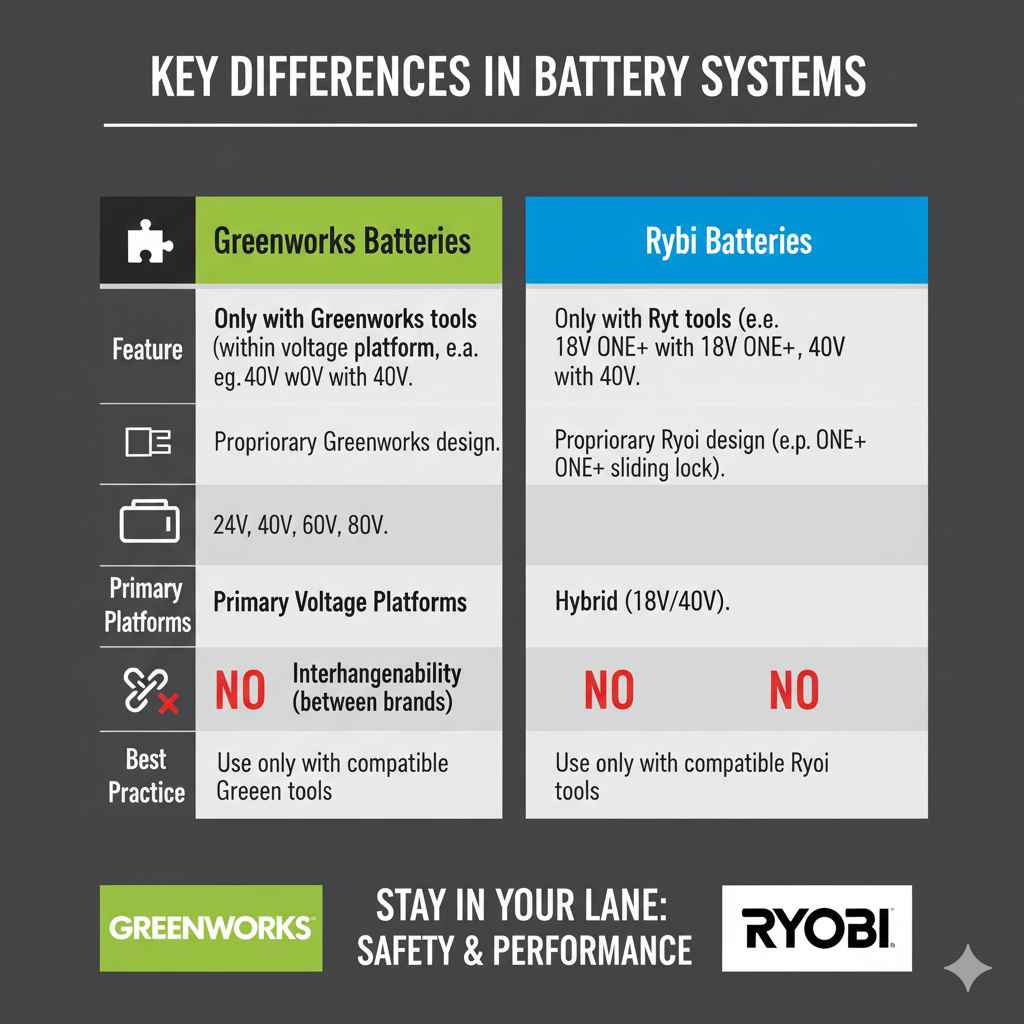
Table: Key Differences in Battery Systems
Let’s summarize the core distinctions in a clear format:
| Feature | Greenworks Batteries | Ryobi Batteries |
|---|---|---|
| Compatibility | Only with Greenworks tools (within voltage platform, e.g., 40V with 40V). | Only with Ryobi tools (e.g., 18V ONE+ with 18V ONE+, 40V with 40V). |
| Connector Type | Proprietary Greenworks design. | Proprietary Ryobi design (e.g., ONE+ sliding lock). |
| Primary Voltage Platforms | 24V, 40V, 60V, 80V. | 18V ONE+, 40V, Hybrid (18V/40V). |
| Interchangeability (between brands) | No | No |
| Best Practice | Use only with compatible Greenworks tools. | Use only with compatible Ryobi tools. |
Frequently Asked Questions (FAQ)
Q1: Can I use a Greenworks 40V battery in a Ryobi 40V tool?
A1: No, you absolutely cannot. While both are 40V, the battery connector designs are entirely different and proprietary to each brand. You risk damaging both the battery and the tool.
Q2: Is there any adapter that lets Greenworks batteries work with Ryobi tools?
A2: While you might find some unofficial or DIY adapters online, they are strongly discouraged. These are not tested, certified, or supported by either manufacturer and can lead to dangerous situations, tool damage, and voided warranties. Always use the battery designed for your tool.
Q3: If I have a Greenworks 24V tool, can I use it with a Greenworks 40V battery?
A3: No. Greenworks (like most brands) uses different voltage systems that are not interchangeable. A 24V tool requires a 24V battery from Greenworks. Using a higher voltage battery would likely destroy the tool.
Q4: My Ryobi ONE+ battery looks similar to another brand’s 18V battery. Are they interchangeable?
A4: It’s highly unlikely. Even within the 18V category, the physical shape of the battery pack, the connector pins, and the internal communication systems are distinct. Ryobi’s slide-on ONE+ system is unique. Stick to genuine Ryobi 18V ONE+ batteries for your Ryobi ONE+ tools.
Q5: What happens if I try to force a battery into a tool it doesn’t fit?
A5: Forcing a battery can damage the delicate electrical contacts in both the battery and the tool. This can lead to a poor connection, preventing the tool from working, or worse, cause a short circuit that permanently damages the tool or the battery pack.
Q6: Where can I find information about which battery goes with which tool?
A6: Always check the label on your tool and battery, or consult the owner’s manual. Manufacturer websites also have detailed specifications and compatibility charts for their product lines. For example, the Greenworks Tools and Ryobi Tools official websites are excellent resources.
Conclusion: Stick to What Works
As a woodworking mentor, I emphasize getting the right tool for the job, and that extends to the power source. While the dream of universal batteries is appealing, the reality is that Greenworks batteries are designed for Greenworks tools, and Ryobi batteries are made for Ryobi tools. Their systems are proprietary, ensuring safety, performance, and reliability. Attempting to use incompatible batteries is a surefire way to damage your expensive tools, void warranties, and potentially create a safety hazard.
So, when you’re expanding your workshop or need a replacement battery, always double-check that you’re buying the correct one for your specific brand and voltage system. It’s the most straightforward and safe way to keep your tools running smoothly and your projects moving forward. Happy building, and always work safely!