DIY Faux Wood Beams: Genius & Essential Guide
Transform your ceiling with beautiful, affordable faux wood beams! This guide breaks down the simple steps for creating stunning faux wood beams yourself, adding warmth and character to any room without the cost or weight of real timber. Get ready to elevate your home décor with this achievable woodworking project.
Ever dream of adding the rustic charm of exposed beams to your home but felt intimidated by the cost or complexity? I get it! Real wood beams can be incredibly heavy, expensive, and require professional installation. It’s a project that often leaves homeowners feeling stuck, wishing for that cozy, architectural detail without breaking the bank. But what if I told you there’s a smarter, easier way? You can achieve that beautiful, designer look yourself with DIY faux wood beams. This guide will walk you through every step, making it simple and rewarding. Let’s dive into creating a stunning focal point for your space that you’ll be proud to say you made!
Why Choose DIY Faux Wood Beams?
Faux wood beams offer a fantastic way to get the look and feel of solid wood without many of the drawbacks. They’re lighter, more affordable, and surprisingly easy to install, making them perfect for a DIY project.
Here’s why they’re such a popular choice:
Cost-Effective: Significantly cheaper than solid wood beams, especially when factoring in installation.
Lightweight: Easy to handle and install, often requiring no special structural support.
Versatile Styles: Can mimic various wood types, finishes, and ages, fitting seamlessly into any décor.
Easy Installation: Typically involve simple assembly and attachment methods.
Adds Architectural Interest: Creates a focal point, adds height, and enhances the character of a room.
Hides Imperfections: Can be used to cover unsightly ceiling elements like ductwork or wiring.
Durable & Low Maintenance: Once installed, they require little to no upkeep.

Understanding Faux Wood Beam Construction
Most DIY faux wood beams are created from lightweight materials like foam (often high-density polystyrene) or hollow wood boxes (usually made from pine or plywood). These materials are then expertly finished to look like real wood.
Foam Beams: These are typically molded and carved to resemble aged wood. They are incredibly light and easy to cut. The main challenge is achieving a realistic wood grain and finish, which often involves multiple layers of paint and texturing.
Hollow Wood Box Beams: These are constructed from lumber, typically three sides of a box (top and two sides), or sometimes all four sides. They offer a more substantial feel than foam and can be easier for some to finish with traditional woodworking techniques. You can buy them pre-made or build them yourself from dimensional lumber.
For beginners, hollow wood box beams built from lumber are often the most approachable, offering a familiar building material and straightforward construction.
Materials & Tools You’ll Need
Gathering your supplies before you start is key to a smooth DIY experience. Don’t worry if some tools seem unfamiliar; we’ll cover their use. Safety first, always!
Essential Materials:
Lumber:
1×4 or 1×6 boards for the sides of your box beams (length will depend on your desired beam size and ceiling span). Pine is a great, affordable choice.
1×8 or 1×10 boards for the “bottom” or “face” of your beam.
A plywood or 1x material for the structural “hanger” that attaches to the ceiling.
Wood Screws: Various lengths, suitable for joining your lumber.
Wood Glue: For added strength at joints.
Wood Filler: To smooth out any imperfections.
Sandpaper: Medium (120-grit) and fine (220-grit).
Wood Stain or Paint: Choose a color and finish that matches your desired look.
Pre-Stain Wood Conditioner (Optional but Recommended): Helps the stain absorb more evenly.
Clear Protective Topcoat: Polyurethane or a similar sealant.
Mounting Hardware: Depending on your ceiling type (e.g., joist hangers, drywall anchors, or screws long enough to hit studs).
Essential Tools:
Measuring Tape: For accurate measurements.
Pencil: For marking cuts.
Safety Glasses: Crucial for protecting your eyes from sawdust and debris.
Work Gloves: To protect your hands.
Hearing Protection: Especially if using power saws.
Circular Saw or Miter Saw: For making straight, accurate cuts. A miter saw is ideal for precise angles.
Drill/Driver: For pre-drilling holes and driving screws.
Drill Bits: Various sizes for pilot holes and countersinking.
Clamps: To hold pieces together while gluing or screwing.
Putty Knife: For applying wood filler.
Paintbrushes/Rags: For applying stain and topcoat.
Stud Finder: To locate ceiling joists for secure mounting.
Level: To ensure beams are straight.
Optional: Router (for decorative edges), Random Orbital Sander (for faster sanding).
Step-by-Step Guide to Building Your DIY Faux Wood Beams
Let’s get building! Follow these steps to create beautiful faux wood beams that will transform your space. We’re focusing on building hollow wood box beams for this guide.
Step 1: Design & Measure Your Beams
Before cutting any wood, carefully plan your beam dimensions and placement.
1. Determine Beam Size: Decide on the width, height, and depth of your beams. Common sizes range from 4 inches to 8 inches wide and 3 inches to 6 inches deep. Consider your ceiling height and the overall scale of the room.
2. Calculate Lumber Needs: Based on your desired beam dimensions, calculate how much lumber you’ll need for the three or four sides of each beam. For example, a beam that is X inches tall and Y inches wide will need two pieces of lumber for the sides and one for the front face.
3. Measure Your Ceiling Space: Measure the length where each beam will go. If you’re placing them across joists, mark the joist locations using a stud finder. This is critical for secure mounting later.
A helpful rule of thumb is to aim for beams that look proportionate to your room. For standard 8-foot ceilings, beams around 6 inches deep often look great. For higher ceilings, you can go deeper.
Step 2: Cut Your Lumber
Accuracy is key here! Double-check your measurements before each cut.
1. Cut Side Pieces: Cut your chosen lumber (e.g., 1×6 pine) to the desired height of your beam. You’ll need two exact lengths for each beam.
2. Cut Front Face Piece: Cut your wider lumber (e.g., 1×8 pine) to the desired width of your beam. You’ll need one length for each beam.
3. Cut Hanger Piece: Cut a piece of plywood or a 1x board to the same length as your front face piece. This will be your mounting cleat. Its width should be slightly less than the desired depth of your beam so it sits inside.
Safety Tip: Wear safety glasses and hearing protection when operating saws. Ensure your workpiece is stable and securely held before cutting.
Step 3: Assemble the Beam Box
Now we start bringing your beam to life! We’ll assemble a three-sided box, leaving the back open for the hanger.
1. Dry Fit: Lay out your two side pieces and the front face piece to visualize the box. The side pieces will butt into the ends of the front face piece.
2. Apply Wood Glue: Run a bead of wood glue along the edges where the side pieces will meet the front face piece.
3. Attach Side Pieces: Position the side pieces against the ends of the front face piece. Clamp them securely.
4. Pre-Drill and Screw: Pre-drill pilot holes through the side pieces into the front face piece. This prevents the wood from splitting. Use 2-3 screws per joint, ensuring they are long enough to create a strong bond.
5. Repeat for Additional Beams: Build each beam box in the same manner.
You can also opt to build a four-sided box if you prefer, but it makes installation slightly trickier as you have to attach it around the hanger. The three-sided method is generally easier for DIYers.
Step 4: Create the Mounting Hanger
This is the part that securely attaches your beam to the ceiling.
1. Prepare the Hanger: Take your cut plywood or 1x board (the hanger piece). It should be the same length as your beam’s front face.
2. Mark and Drill Holes: Lay the hanger piece on your workbench. Mark evenly spaced points along its length where you will drill screw holes. These holes will go into your ceiling joists or wall studs.
3. Pre-Drill: Pre-drill clearance holes through the hanger. The size should be appropriate for the screws you’ll use to attach it to the ceiling.
Step 5: Finish Your Beams (The Realistic Magic!)
This is where the “faux” wood really comes alive and looks authentic. This step takes patience but is incredibly rewarding. You can stain and seal your beams before or after installation, but pre-finishing is often easier.
1. Sand: Lightly sand all surfaces of your beam boxes with medium-grit sandpaper, followed by fine-grit. This smooths out any rough spots.
2. Wipe Clean: Remove all dust with a tack cloth or damp rag.
3. Apply Wood Conditioner (Optional): If using stain, apply a pre-stain wood conditioner according to the product instructions. This helps create a more even stain application.
4. Stain: Apply your chosen wood stain. For a realistic look, consider using multiple stain colors or techniques.
Base Coat: Apply a lighter base stain if desired.
Darker Stain/Glaze: Once the base coat is dry, apply a darker stain or a glaze to create depth and highlight the wood grain. Wipe off excess to reveal variations.
Dry Brushing (Optional): Lightly brush on a contrasting color (like a lighter brown or even white/grey) with a dry brush to mimic the look of aged or distressed wood.
5. Let Dry: Allow the stain to dry completely, following the manufacturer’s instructions.
6. Apply Topcoat: Apply 2-3 coats of a clear protective topcoat (like semi-gloss or satin polyurethane). Lightly sand between coats with fine-grit sandpaper for a smooth finish.
Pro Tip for Realism: Look at real rustic beams for inspiration. Notice the variations in color, the knots, and the grain patterns. You can experiment with different brush strokes and stain layering to achieve a unique, aged look.
Step 6: Install the Mounting Hangers
This is a crucial step for secure installation.
1. Locate Joists/Studs: Use your stud finder to locate ceiling joists. Mark their exact locations.
2. Position Hangers: Hold your prepared hanger piece against the ceiling at the desired location. Use your level to ensure it’s perfectly straight.
3. Attach Hangers: Drive screws through the pre-drilled holes in the hanger into the ceiling joists or studs. Use long, sturdy screws appropriate for your ceiling type. If screwing into drywall only, use heavy-duty drywall anchors rated for significant weight.
Important Note: The hanger must be securely fastened to the structure of your ceiling (joists or studs). Do not rely solely on drywall anchors if you can avoid it. Consult a professional if you are unsure about your ceiling’s structural integrity.
Step 7: Install the Faux Wood Beams
This is the final, satisfying step!
1. Apply Glue (Optional but Recommended): Run a bead of wood glue along the top inside edges of your beam box that will meet the ceiling.
2. Position the Beam: Carefully lift the beam box and slide it over the installed hanger cleat. The open back of the beam box should enclose the cleat.
3. Secure the Beam:
From the Sides: Pre-drill and screw from the sides of the beam box into the hanger cleat. Countersink these screws so they’re hidden.
From the Bottom (Optional): You can also pre-drill and screw vertically from the bottom face of the beam box up into the hanger cleat. Use shorter screws here to avoid going through the hanger.
4. Attach Additional Beams: Repeat the process for all your beams.
5. Fill & Touch Up: Once all beams are installed, use wood filler to fill any visible screw holes from the bottom or sides. Sand these areas smooth and touch up the stain and topcoat as needed to blend them seamlessly.
Enhancing Realism: Adding Texture and Details
Want to take your faux wood beams to the next level? Here are a few ideas to make them look even more authentic and compliment your home’s style:
Create a Wood Grain: Before staining, you can use a stiff wire brush or a wood-graining tool on the wood surface to create a more pronounced grain pattern.
Add “Cracks” and “Checks”: Carefully use a router or even a chisel to create small, intentional cracks or checks that mimic natural wood aging. Feather the edges and blend them with your stain.
Incorporate “Knots”: You can purchase artificial wood knots or create your own from wood filler. Press them into the wood while it’s still wet or after texturing.
Distress the Edges: Lightly sand or use a rasp to soften sharp edges, making them look worn over time.
Use Multiple Stain Techniques: Experiment with layering stains, washes, and glazes to achieve depth, variation, and an aged patina.
Consider “Mortise and Tenon” Details: You can add trim pieces that mimic mortise and tenon joinery for a more structural, finished look.
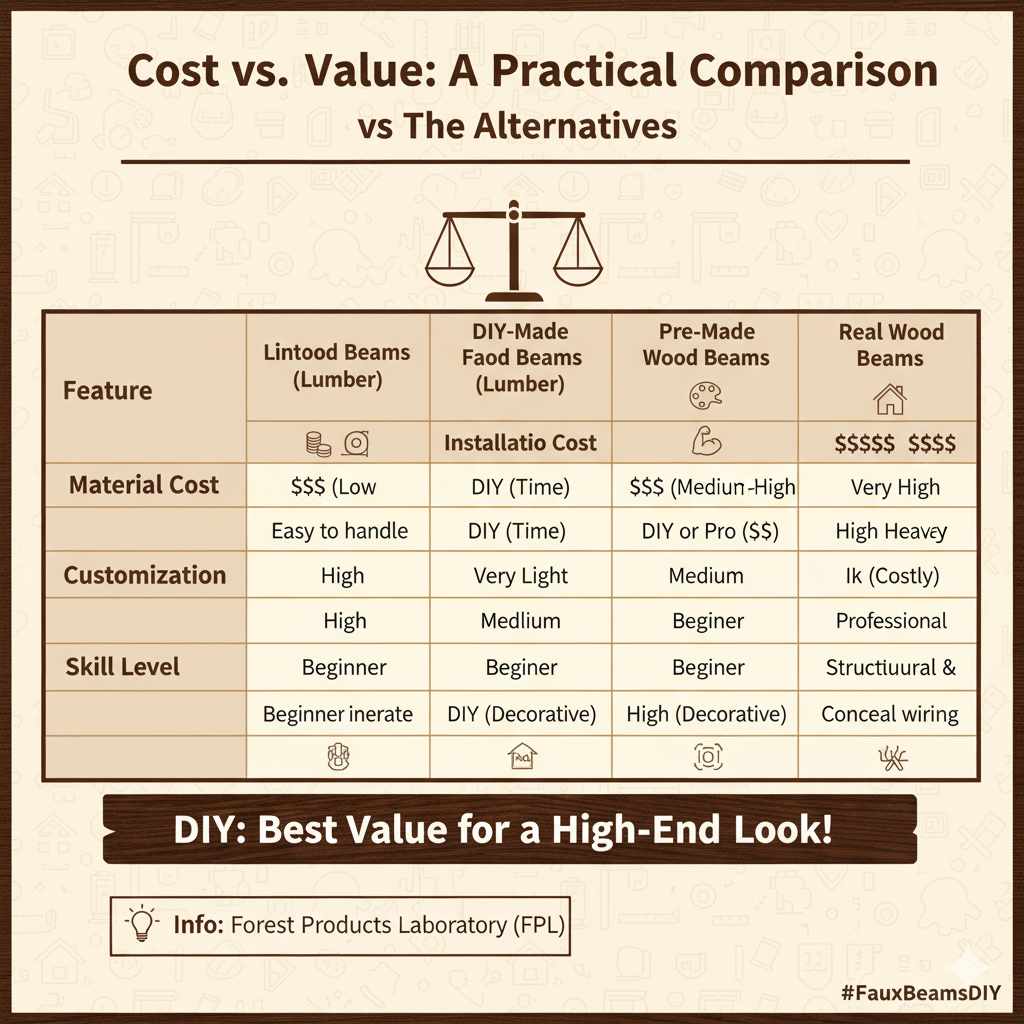
Cost vs. Value: A Practical Comparison
Let’s look at the numbers. Building your own faux wood beams offers a significant cost advantage over purchasing pre-made beams or using real timber.
| Feature | DIY Faux Wood Beams (Lumber) | Pre-Made Faux Wood Beams | Real Wood Beams |
|---|---|---|---|
| Material Cost | $$ (Low) | $$$ (Medium-High) | $$$$$ (Very High) |
| Installation Cost | DIY (Time) | DIY or Professional ($$) | Professional ($$$$) |
| Weight | Light | Very Light | Very Heavy |
| Customization | High | Medium | High (but costly) |
| Skill Level | Beginner-Intermediate | Beginner | Professional |
| Durability | High (for decorative purposes) | High (for decorative purposes) | Structural & Decorative |
The DIY route provides the best value for homeowners looking for a beautiful aesthetic upgrade without a hefty price tag. You’re investing your time and gaining valuable skills while achieving a high-end look.
For resources on wood types and their properties, the Forest Products Laboratory (part of the U.S. Forest Service) offers a wealth of information.
Frequently Asked Questions (FAQ)
Here are some common questions beginners have about installing DIY faux wood beams.
Q1: How do I attach beams to a plaster ceiling?
A1: Similar to drywall, you need to find the structural joists above the plaster. Use a good stud finder designed for thicker materials. If joists aren’t accessible or you can’t screw directly into them, use heavy-duty toggle bolts or specialized plaster anchors rated for the beam’s weight. However, securing to structural wood is always the safest bet. If unsure, consult a handyman or contractor.
Q2: Can I use these beams for structural support?
A2: No. DIY faux wood beams, whether made from foam or hollow boxes, are purely decorative. They are not engineered to carry any structural load. Ensure they are attached securely to your ceiling’s structure for their own weight and to prevent them from falling.
Q3: What’s the best way to make them look like real, old wood?
A3: The key is layering and imperfection. Use multiple stain colors. Apply a base coat, then a darker glaze to settle into the grain. You can also use a dry brush technique with a lighter color or even a touch of grey or white to mimic age and wear. Creating slight imperfections with a wire brush or by distressing edges can also enhance realism.