Does Wood Expand In Cold Or Heat: Essential Facts
Wood expands primarily due to heat and moisture. While it shrinks slightly in extreme cold, the most significant expansion and contraction happens with changes in humidity and temperature. Understanding this is key for any woodworking project to ensure durability and prevent issues like warping or cracking.
Welcome to the workshop! If you’ve ever wondered why a wooden door might stick in the summer but fit perfectly in the winter, or why your carefully crafted shelf bowed over time, you’re not alone. Wood is a natural material, and like all natural things, it reacts to its environment. The most common question I get is about wood expansion and contraction: “Does wood expand in cold or heat?” The answer is a bit nuanced, but understanding it is fundamental to building beautiful, long-lasting projects. Don’t worry if this sounds complicated; we’ll break it down into simple, easy-to-understand facts. By the end of this guide, you’ll know exactly how temperature and moisture affect wood, and how to work with it to avoid common headaches. Let’s get started!
Does Wood Expand In Cold Or Heat? The Core Principles
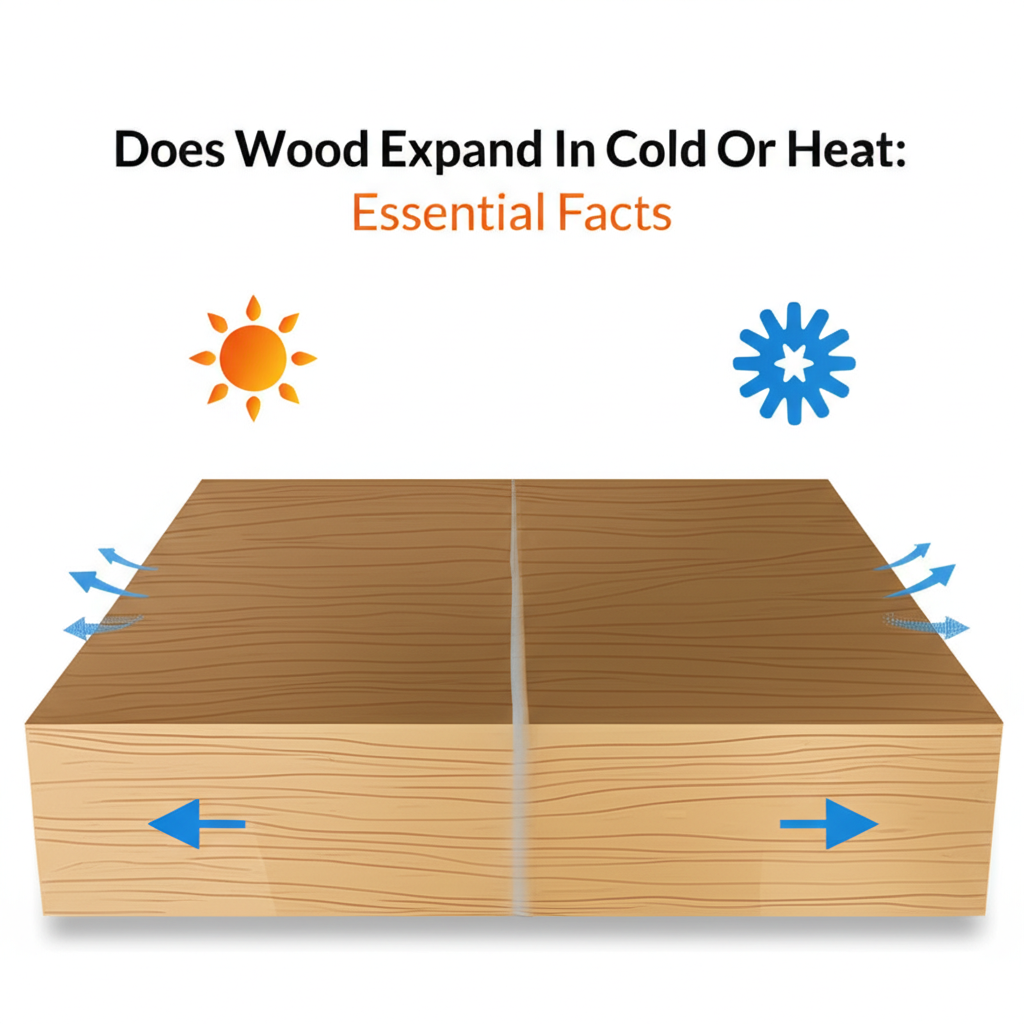
At its heart, wood is made up of tiny cells, much like a sponge. These cells contain moisture, and it’s this moisture content that plays the biggest role in how wood behaves. When the temperature rises, especially when combined with increased humidity, the moisture within the wood cells can increase. This moisture causes the cell walls to swell, leading to expansion. Conversely, in cold temperatures, the moisture content in wood tends to decrease as the air dries out, and the wood will contract.
However, it’s crucial to remember that wood is anisotropic, meaning it expands and contracts differently in different directions. Wood expands and contracts much more across the grain (perpendicular to the growth rings) than it does along the grain (parallel to the length of the tree). This is a fundamental concept that influences how we design and build with wood.
Understanding Wood’s Reaction to Temperature
When we talk about wood expanding in heat, it’s often a combination of thermal expansion and increased moisture absorption. Heat itself can cause materials to expand, but wood’s primary reaction to heat is often mediated by its moisture content. Warmer air can hold more moisture. If the surrounding air is humid and warm, the wood will absorb that moisture, causing it to swell.
In cold weather, the air typically holds less moisture. This dry air can actually draw moisture out of the wood, causing it to shrink. So, while heat can lead to expansion (especially if it brings moisture with it), cold weather, due to its drying effect, usually leads to shrinkage. This is why a piece of wood might seem to fit perfectly in a dry, cold workshop but become snug or even jammed in a warm, humid environment.
The Role of Moisture Content in Wood Movement
Moisture is the real driver behind most of wood’s expansion and contraction. The “moisture content” of wood refers to the amount of water it contains, expressed as a percentage of the wood’s oven-dry weight. Freshly cut wood, often called “green” lumber, can have a moisture content of 50% or more. As wood dries, it shrinks. This drying process is most pronounced when the wood’s moisture content drops below 30% and continues down to about 25% moisture content. Below this point, further drying doesn’t cause significant shrinkage.
This critical point is known as the “fiber saturation point.” Above the fiber saturation point (around 25-30% moisture content), wood cells are saturated with water, and any changes in moisture content don’t significantly affect the wood’s dimensions. However, as the wood dries and moisture is removed from the cell walls themselves (below the fiber saturation point), the wood shrinks. Conversely, as wood absorbs moisture from the air, its cells swell, causing expansion.
Thermal Expansion vs. Moisture Movement in Wood
It’s important to distinguish between thermal expansion and moisture-induced movement. All materials expand when heated and contract when cooled due to the increased or decreased kinetic energy of their molecules. This effect is present in wood, but it’s relatively minor compared to the expansion and contraction caused by changes in moisture content. For example, a study by the Forest Products Laboratory found that the coefficient of thermal expansion for wood along the grain is very small, on the order of 5.5 x 10^-6 per degree Celsius. Across the grain, it’s larger, but still generally less impactful than moisture changes.
The majority of the “expansion and contraction” issues woodworkers encounter are due to the wood absorbing or releasing moisture from the surrounding atmosphere. This is why proper drying and conditioning of wood before use, and accounting for seasonal humidity changes in finished pieces, are so vital.
How Wood Expands and Contracts: Direction Matters
As mentioned, wood doesn’t expand or contract uniformly in all directions. This anisotropic behavior is a direct result of the tree’s growth structure. Understanding these differences is key to preventing problems.
Expansion and Contraction Across the Grain
The most significant movement in wood occurs perpendicular to the grain, meaning across the width and thickness of a board. This is because the cell walls in wood are arranged in a way that makes them more susceptible to swelling and shrinking when they absorb or lose moisture. Imagine a bundle of straws; if you were to add water between the straws, they would spread apart more easily than if you tried to push them together along their length.
This transversal movement is why you see wider boards cup or warp more readily than narrower ones, and why a tight-fitting joint might loosen or bind as humidity changes. Typically, wood can expand or contract by up to 1% to 10% across the grain relative to its dry dimensions, depending on the species and the severity of moisture change.
Expansion and Contraction Along the Grain
Movement along the grain (lengthwise) is considerably less pronounced. The wood fibers, being long and parallel, offer more resistance to swelling and shrinking along their length. While there is still some movement, it’s usually negligible for most woodworking projects, often less than 0.5% from green to oven-dry conditions.
This is why the choice of how to cut lumber from a log—as flatsawn or quartersawn—can significantly impact performance. Quartersawn lumber, where the growth rings are closer to perpendicular to the face of the board, tends to be more stable and less prone to cupping and shrinking than flatsawn lumber.
Factors Affecting the Rate of Expansion and Contraction
Several factors influence how much and how quickly wood moves:
- Wood Species: Different types of wood have varying densities and cell structures, leading to different rates of movement. Dense hardwoods often move more than softwoods. For example, Oak generally moves more than Pine.
- Moisture Content Change: The greater the change in humidity and, consequently, moisture content, the greater the dimensional change in the wood.
- Temperature Fluctuations: While moisture is the primary driver, rapid temperature swings can accelerate moisture exchange between the wood and the environment.
- Grain Orientation: As discussed, movement across the grain is much greater than along the grain.
- Wood Treatments: Kiln-drying, steaming, and other wood treatments can affect the wood’s cell structure and its propensity to absorb or release moisture.
Wood Movement in Different Seasons
Understanding how wood behaves throughout the year is practical for anyone working with wood, especially those building outdoor furniture or wooden structures that are exposed to the elements.
Wood in Summer (Warm and Humid)
Summer often brings warmer temperatures and higher humidity, particularly in many regions. This combination is a recipe for wood expansion. The warmer air can hold more moisture, and if that moisture reaches the wood, the wood fibers will absorb it and swell. This is why wooden doors might become difficult to close on a humid summer day, or why a deck board might seem to have less gap between it and its neighbor compared to winter.
For indoor projects, if your home’s air conditioning runs in the summer, it effectively dehumidifies the air. This can cause wood to dry out and potentially shrink slightly, counteracting the typical summer expansion. The key is the relative humidity.
Wood in Winter (Cold and Dry)
Winter typically brings colder temperatures and drier air. Cold air holds significantly less moisture than warm air. As a result, the dry winter air can pull moisture out of wooden objects. This causes the wood to shrink.
Think about your wooden furniture indoors during winter. If you have a heating system running, especially a forced-air furnace, it can dramatically lower the indoor humidity. This dry air will cause indoor wood to shrink. You might notice gaps appearing in tabletops, drawers becoming looser, or wooden floors developing small gaps between boards that were tight in the summer.
Practical Implications for Woodworkers
Now that we know how wood moves, let’s talk about what this means for your projects. Ignoring wood movement is one of the quickest ways to cause a beautiful piece of furniture or carpentry to fail.
Choosing the Right Lumber
When selecting lumber, consider its intended use and environment. If you’re building something that will experience significant seasonal changes, like outdoor furniture or a garden bench, choosing stable wood species is crucial. For indoor projects, understanding the typical humidity fluctuations in your home is also important. Kiln-dried lumber is generally preferred for most projects because it has been dried to a specific moisture content (usually 6-12% for interior use), making it more stable than air-dried or green lumber.
You can find resources on the stability of different wood species from organizations like the Woodworking Network, which often detail their movement characteristics.
Accounting for Wood Movement in Joinery
This is where the magic (and science) of woodworking really comes into play. For solid wood pieces that are wider than about 6 inches, you must account for the expansion and contraction across the grain.
- Tabletops and Boards: When joining multiple boards together to create a wider surface, like a tabletop, each board needs to be able to move independently without stressing the overall structure. This is typically achieved by using “breadboard ends” or by floating the top on a frame using sliding dovetails, tongue-and-groove joinery, or metal fasteners designed to allow movement.
- Drawer Slides: Drawer sides and bottoms are often made of solid wood. The dadoes (grooves) in the cabinet sides where the drawer sides slide should be slightly wider than the drawer side’s thickness to allow for seasonal expansion without binding.
- Panel-and-Frame Construction: In doors and raised-panel cabinets, the solid wood panels are often set into grooves in the frame. These panels should be slightly undersized to allow them to shrink and expand without pushing the frame apart.
Finishing and Sealing Wood
Applying a finish, such as varnish, polyurethane, oil, or paint, can help to moderate the rate at which wood absorbs or loses moisture from the air. A good finish acts as a barrier, slowing down moisture exchange.
However, it’s important to apply a finish to all surfaces of the wood, including end grain and edges. If one side is sealed and the other is exposed to the environment, the wood will dry or absorb moisture unevenly, leading to warping or cracking. This is known as “uneven moisture exchange.” Apply your finish evenly, and consider multiple coats for maximum protection, especially for items exposed to varying humidity levels.
Common Woodworking Projects and Movement Considerations
Let’s apply this knowledge to a few common projects:
Building Coffee Tables or Dining Tables
These often involve joining several wide boards to create a large surface. If you simply glue all the boards edge-to-edge and then attach solid wood legs directly to the underside using glue and screws, you are essentially locking that wood into place. As the seasons change and the tabletop expands or contracts, the forces generated can overcome the glue bond or even split the wood, especially if the movement is restricted by the frame or legs.
The solution is to use a joinery method that allows the tabletop to “float.” This could involve:
- Figure-8 Fasteners: These metal clips fit into a mortise on the apron (the frame beneath the top) and a slot on the underside of the tabletop, allowing for movement.
- Z-Clips or Tabletop Fasteners: Similar to figure-8s, these metal clips slide into a dado in the apron and screw into the underside of the top.
- Sliding Dovetails: A groove is cut into the apron, and a matching dovetail tenon is left on the underside of the tabletop. The tabletop slides into the apron, allowing for movement along the length of the groove.
Constructing Wooden Doors
Whether it’s an interior or exterior door, solid wood panels within a frame are susceptible to movement. If a panel that has swelled is trying to expand within a fixed frame, it can exert significant pressure on the rails and stiles, potentially causing them to split or joints to fail. Conversely, if the panel shrinks, it can leave a gap, making the door look unfinished or allowing drafts.
The standard approach is to set the solid wood panel into a groove in the door’s frame. This groove is typically made slightly wider than the panel’s thickness. The panel is then secured to the frame using a method that allows it to expand and contract freely. Sometimes small staples or specialized clips are used, or the panel might be held in place by a secondary element like a decorative molding that is attached in a way that permits movement.
Building Wooden Shelves
For shorter shelves (say, under 3 feet), movement might be less of a concern unless the conditions are very extreme. However, for longer shelves, especially those made from wider boards, you need to consider how they are supported.
- Shelf Supports: If you’re using shelf pins or brackets, ensure the holes or slots into which the shelf sits are slightly larger than the shelf’s thickness or width, depending on the orientation.
- Fixed Shelving: If shelves are rigidly fixed (e.g., dadoed into the sides of a cabinet), consider using narrower boards or accounting for the expansion with slightly oversized dadoes.
- Reinforcement: For very long shelves, an often-overlooked technique is adding a “cleat” or a reinforcing strip along the back edge of the shelf. This cleat should be attached via a method that allows the shelf board to move relative to the cleat, often by using elongated screw holes.
Table: How Different Wood Species React to Moisture
Understanding that different wood species have different movement characteristics is crucial for project planning. Here’s a simplified look at some common hardwoods and softwoods, noting their general tendency to expand and contract with moisture changes. Keep in mind that kiln-drying and finishing will impact these behaviors significantly.
| Wood Species | Typical Movement (Across Grain) | Notes |
|---|---|---|
| Oak (Red & White) | High | Very common, but known to move significantly. White oak is generally more stable than red oak. |
| Maple (Hard & Soft) | Medium to High | Hard maple is quite stable if properly dried but will move. Soft maple moves more. |
| Walnut | Medium | A popular hardwood with moderate movement. |
| Cherry | Medium | Known for its beauty and moderate stability. |
| Pine (Eastern White) | Low to Medium | A softwood that is relatively stable, making it good for many projects. |
| Fir (Douglas) | Medium | A strong softwood, commonly used in construction, with moderate movement. |
| Poplar | Medium | Economical and easy to work, but has moderate movement. |
Note: “High,” “Medium,” and “Low” are relative terms. All solid wood will move to some extent. The actual percentage of movement depends on the specific drying process and the extent of moisture change. For precise figures, consult wood datasheets from reputable sources like the Forest Products Laboratory.
Frequently Asked Questions (FAQ)
Let’s address some common questions beginners have about wood movement.
Q1: Does wood shrink or expand more, or is it about the same?
Wood shrinks when it dries and expands when it absorbs moisture. Generally, the drying process (shrinking) and the wetting process (expanding) are not perfectly symmetrical for a given piece of wood. However, for practical purposes in woodworking, we often refer to the total potential movement from fully wet to fully dry as its movement characteristic. The key takeaway is that significant dimensional changes, both shrinking and swelling, occur throughout the year due to fluctuating humidity.