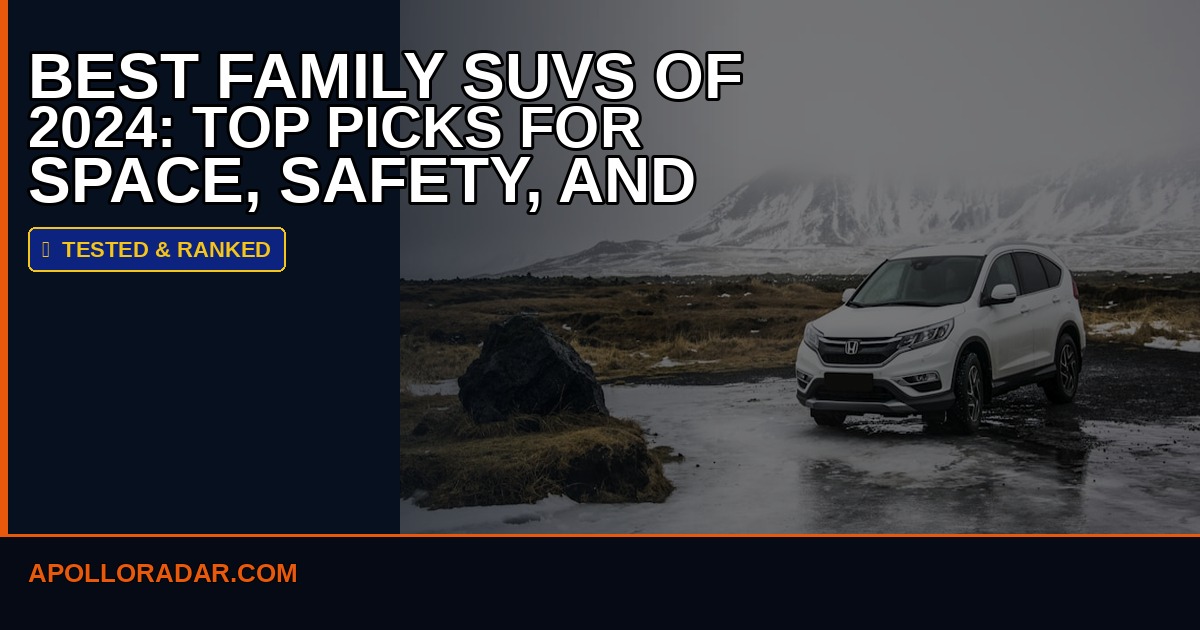
Best Family SUVs of 2026: Top Picks for Space, Safety, and Value
The three-row family SUV segment has never been more competitive than in 2026. Nearly every major automaker now offers a compelling option in the $36,000 to $55,000 range, with strong safety ratings, spacious interiors, and advanced driver assistance technology as near-universal features. But each model makes different trade-offs, and the right choice depends on your family’s specific priorities. This guide covers the five best family SUVs of 2026 in depth, with a head-to-head comparison to help you make the decision with confidence.
What Makes a Great Family SUV in 2026
The best family SUVs balance several competing requirements: genuine three-row seating with usable space in the third row, not just emergency seating for small children; strong crash test performance from NHTSA and IIHS; fuel economy that doesn’t punish you on family road trips; cargo space behind the third row sufficient for luggage or stroller; and a reliability record you can trust for a vehicle that needs to start every morning for the next decade. Advanced driver assistance — automatic emergency braking, blind spot monitoring, rear cross-traffic alert — is now standard or near-standard across the segment and should be a baseline expectation, not a premium feature.
1. Kia Telluride: Best Overall Value at $38,290
The Kia Telluride has held the best-value position in the family SUV segment for several years, and the 2026 model maintains that reputation with a starting price of $38,290 for the LX trim. The Telluride’s interior quality punches significantly above its price point — the materials, fit, and finish feel closer to luxury competitors than mainstream ones. The standard 3.8-liter V6 produces 291 horsepower and pairs with an 8-speed automatic transmission for smooth, capable performance. EPA fuel economy is 20 city and 26 highway for FWD models, with AWD dropping that slightly to 19/24.
Third-row access and comfort in the Telluride are genuine strengths. The second-row captain’s chairs option creates a walk-through aisle that adults can navigate without contorting, and the third row offers 31.5 inches of legroom — adequate for adults on shorter trips. Cargo behind the third row measures 21 cubic feet, expanding to 87 cubic feet with all seats folded. The Telluride’s combination of standard safety features — forward collision warning, automatic emergency braking, driver attention warning, lane keeping assist — across all trims is among the most generous in the segment.
2. Honda Pilot: 8-Seat Capacity and Proven Reliability at $39,050
The Honda Pilot is the choice for families who need maximum passenger capacity. Starting at $39,050, the Pilot’s optional third-row bench seat (available on certain trims) brings total capacity to eight passengers — one more than most competitors. The 285-horsepower 3.5-liter V6 is paired with a 10-speed automatic that delivers smooth, confident power delivery whether merging on the highway or climbing grades with a full passenger load. Fuel economy of 20 city and 27 highway (FWD) is competitive for the class.
Honda’s reliability record across its SUV lineup is consistently above average in long-term owner surveys and Consumer Reports data. The Pilot’s drivetrain, in particular, has a strong track record over multiple vehicle generations. The second-generation infotainment system introduced in the current Pilot generation has resolved the touch-sensitivity issues that plagued earlier iterations, and Honda Sensing — which includes adaptive cruise control, lane centering, and traffic sign recognition — is standard on every trim. The Pilot’s resale value also remains strong, which matters for total cost of ownership calculations.
3. Toyota Highlander Hybrid: Best Fuel Economy at $40,620
For families who do significant highway mileage or live in urban environments with stop-and-go traffic, the Toyota Highlander Hybrid at $40,620 presents a compelling efficiency case. EPA-rated at 36 combined MPG, the Highlander Hybrid delivers fuel economy that is nearly double what some competitors achieve — in real-world mixed driving, owners regularly report 34 to 38 MPG. Over 15,000 miles annually at $3.50 per gallon, the Highlander Hybrid saves approximately $750 to $1,000 per year in fuel costs compared to a 22 MPG non-hybrid SUV.
Toyota’s hybrid system in the Highlander uses a 2.5-liter four-cylinder engine paired with electric motors at the front and rear, producing a combined 243 horsepower. The system prioritizes efficiency over performance — 0-60 takes approximately 7.0 seconds — but in normal family driving scenarios, the power delivery is adequate and the seamless electric assist at low speeds makes urban maneuvering effortless. Toyota’s reputation for long-term reliability is the strongest in the mainstream automotive segment, and the hybrid drivetrain carries an 8-year/100,000-mile powertrain warranty.
The Mazda CX-90 entered the three-row SUV segment in 2024 and has quickly established itself as the choice for buyers who want genuine luxury feel without crossing into the $55,000-plus territory of Audi, BMW, or Cadillac. Starting at $41,245, the CX-90 features interior materials that are indistinguishable from vehicles costing $15,000 to $20,000 more. Real wood trim, genuine leather upholstery on mid and upper trims, and a thoughtfully organized cockpit make it the most premium-feeling vehicle in this comparison.
The standard powertrain is a turbocharged 3.3-liter inline-six producing 280 horsepower, or a plug-in hybrid (PHEV) variant producing 323 horsepower with approximately 26 miles of electric-only range. The PHEV version ($48,445) is an excellent choice for families who primarily drive shorter distances and can charge at home regularly. Mazda’s i-Activ AWD system is among the most capable in the mainstream segment, with terrain management modes and genuine all-weather confidence. The CX-90’s one weakness is a tighter third row compared to the Telluride and Pilot — it’s best for children or shorter adults on trips under two hours.
5. Subaru Ascent: Standard AWD and Safety Leadership at $36,995
The Subaru Ascent makes its case on three pillars: all-wheel drive as standard equipment on every trim (not an option), industry-leading safety ratings, and the lowest entry price among our top five at $36,995. Every Ascent comes with Subaru’s Symmetrical AWD — a permanent, mechanical system that provides genuine all-weather traction rather than the part-time electronic AWD systems found on lower trims of some competitors. For families in the Snow Belt, Pacific Northwest, or mountain regions, standard AWD is a significant practical advantage.
The Ascent has received IIHS Top Safety Pick+ status consistently, with particularly strong small overlap front and side crash test results. EyeSight driver assistance — Subaru’s camera-based system covering adaptive cruise, pre-collision braking, and lane keeping — is standard across the lineup. The 2.4-liter turbocharged four-cylinder produces 260 horsepower and returns approximately 21 city and 27 highway MPG. Cargo capacity behind the third row is 17.8 cubic feet — slightly less than the Telluride — but the overall usability is excellent with thoughtful storage pockets and compartments throughout the interior.
2026 Family SUV Head-to-Head Comparison
| Model | Starting Price | MPG (Combined) | Seating | Best For |
|---|---|---|---|---|
| Kia Telluride | $38,290 | 23 mpg | 7–8 | Best overall value |
| Honda Pilot | $39,050 | 23 mpg | 7–8 | Reliability & max seats |
| Toyota Highlander Hybrid | $40,620 | 36 mpg | 7–8 | Fuel efficiency |
| Mazda CX-90 | $41,245 | 25 mpg | 7 | Luxury feel |
| Subaru Ascent | $36,995 | 24 mpg | 7–8 | Standard AWD & safety |
Which Family SUV Is Right for Your Family?
The Kia Telluride is the best choice for most families because it delivers the highest overall package — interior quality, third-row comfort, standard safety features, and value — without making significant compromises in any area. The Honda Pilot is the pick if maximum passenger count matters or if you prioritize long-term reliability above all else. The Toyota Highlander Hybrid is the clear choice for high-mileage families or those in urban environments where the fuel savings make a compelling financial case. The Mazda CX-90 serves buyers who want a luxury SUV experience without the luxury badge price premium. The Subaru Ascent is purpose-built for families in snowy or mountainous regions where standard AWD provides genuine peace of mind.
All five vehicles have earned strong safety ratings and offer comprehensive standard driver assistance features in 2026. The decision ultimately comes down to budget, geography, and whether you prioritize interior refinement, efficiency, reliability, or maximum capacity. Test drive your top two choices with your family — children included — before making the final decision, as real-world fit, sight lines, and third-row access are aspects that no spec sheet can fully capture.
Frequently Asked Questions
Which 2026 family SUV has the most cargo space?
The Kia Telluride leads the comparison with 87 cubic feet of maximum cargo space with all seats folded, and 21 cubic feet behind the third row. The Honda Pilot is close behind at 83.9 cubic feet maximum. The Mazda CX-90 has the least cargo space in the comparison at 14.4 cubic feet behind the third row, making it a better fit for smaller families or those who rarely use the third row.
For families driving more than 12,000 miles annually, yes. The Highlander Hybrid’s 36 MPG combined rating versus the standard Highlander’s 24 MPG combined saves approximately $750 to $1,000 per year in fuel at current prices. The hybrid premium of approximately $3,500 to $5,000 over the standard model pays back in fuel savings within four to six years, and Toyota’s hybrid reliability record means the system is unlikely to add significant maintenance costs.
Does the Subaru Ascent have better AWD than other SUVs in this comparison?
Yes, for most real-world scenarios. The Ascent’s Symmetrical AWD is a permanent mechanical system that actively distributes torque to all four wheels at all times, rather than a reactive electronic system that engages AWD only when wheelspin is detected. This makes the Ascent meaningfully more capable in snow, ice, and loose-surface conditions compared to competitors with part-time or electronically-managed AWD on base trims. The Telluride, Pilot, and CX-90 also offer excellent AWD systems on mid and upper trims.
How does the Mazda CX-90 compare to the Kia Telluride in third-row comfort?
The Kia Telluride has a more comfortable third row for adult passengers. The Telluride offers 31.5 inches of third-row legroom versus the CX-90’s approximately 28 inches. For families where the third row will regularly carry adult passengers on longer trips, the Telluride is the better choice. The CX-90’s third row is best suited for children or occasional adult use on trips under 60 to 90 minutes.
What should I prioritize when choosing a family SUV in 2026?
Prioritize in this order: safety ratings (IIHS Top Safety Pick+ as a baseline), reliable standard driver assistance features, genuine usable third-row space if you plan to use it regularly, and then overall value at your budget. After those criteria are met, features like fuel efficiency, interior premium feel, and technology level are personal preference decisions. All five SUVs in this comparison meet the safety and driver assistance baseline, so the decision can legitimately come down to value, fuel economy, and interior quality.
About the Author
Marcus Klein
Senior Automotive Editor · 9 Years Experience
Marcus Klein has tested over 80 vehicles and covered automotive trends for 9 years. He specializes in SUVs, EVs, and finding real value in the $20k–$45k market. Every recommendation on Apollo Radar is backed by hands-on research, IIHS safety data, and J.D. Power reliability scores — not dealership pressure.